In August 2025, OXMIQ came out of stealth with $20 million in seed funding and a thesis from Raja: software-architecture compatibility is the unsolved problem in AI hardware, and solving it requires rethinking the GPU stack from Atoms to Agents.
This first newsletter looks at the commitments made at launch, where each product stands now, and what Q1 brought. Here's an update on where each one is:
OxCapsule. A dynamic GPU container technology that abstracts hardware complexity for heterogeneous deployment. The early signal in August was that OXMIQ's own engineering staff depended on it internally to develop across NVIDIA, Tenstorrent, Intel, AMD, Mac on Linux, Windows, and MacOS.
We launched the public beta in November. The product has shipped a steady cadence of updates each month since, and adoption has compounded. Take a look at our numbers.
Numbers since launch:
- 14,563 hours of compute used
- 9,704 sessions
- Roughly 150 systems and 300 GPUs running the stack
- 10 universities and 20 companies using it in real workflows
Our GitHub and Discord communities are active, with developers running the stack, filing issues, and contributing back. To join the OxCapsule Beta, signup here oxmiq.ai/blog/oxcapsulebetalaunch
OxPython. A bridge from the Python-CUDA ecosystem to non-NVIDIA hardware, with an initial Tenstorrent launch committed for end of 2025.
Since then, we have proven OxPython on silicon. Llama 3, DeepSeek, EfficientNet, and CogVideo all run on Tenstorrent's Wormhole and Blackhole hardware through OxPython. These four were a customer deliverable for a paying engagement, now shipped. Three different kinds of AI workloads (language, vision, and video), all running through the same layer. No proprietary frameworks. No code rewrites. The standard PyTorch and CUDA workflows developers already use, on non-NVIDIA hardware. More models are running internally and will be announced soon. The bridge is real.
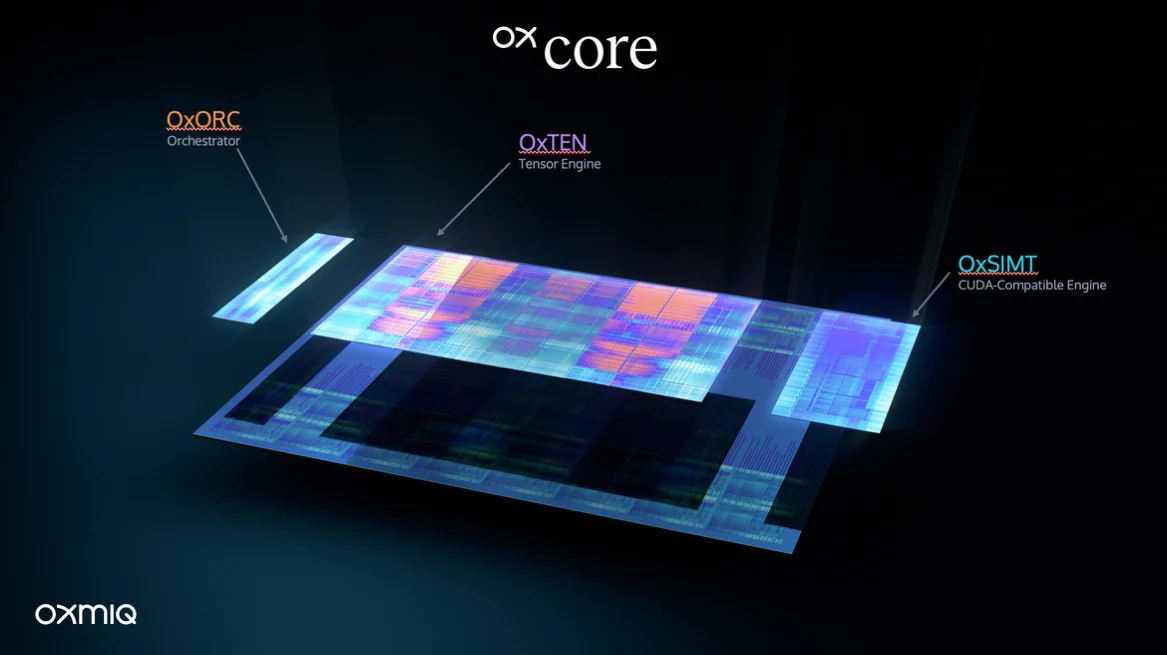
OxCore. We committed at launch to OxCore being available for license in the first half of 2026. OxCore is integrated with three engines OxTEN, OxSIMT, and OxORC, and gpt-oss is now running on the OxCore FPGA, generating tokens. The architecture has moved from specification into validated silicon behavior on schedule. That is the prerequisite for the 1H 2026 license commitment, and we are tracking to it.
OxQuilt. A tool and architecture set for configuring chiplet-based designs around OxCore. Our claim at launch was that packaging chiplets from a library is 20 to 100x less expensive in R&D than taping out custom silicon. The 1H 2026 license target applies here as well, and the work is tracking against it.
For OxQuilt, we introduced OxSOL (Speed of Light), a pre-silicon simulator that lets customers virtually configure and test OxQuilt chiplet packages before committing to a physical build. Raja demonstrated the power of OxSol when he configured an OxQuilt with stacked DRAM in his Chiplet Quilting for the Age of Inference keynote.
Q1 2026: AM Intelligence Labs Partnership
The headline event of Q1 was a customer engagement that did not appear in the original roadmap and reframes the licensing-first thesis at scale.
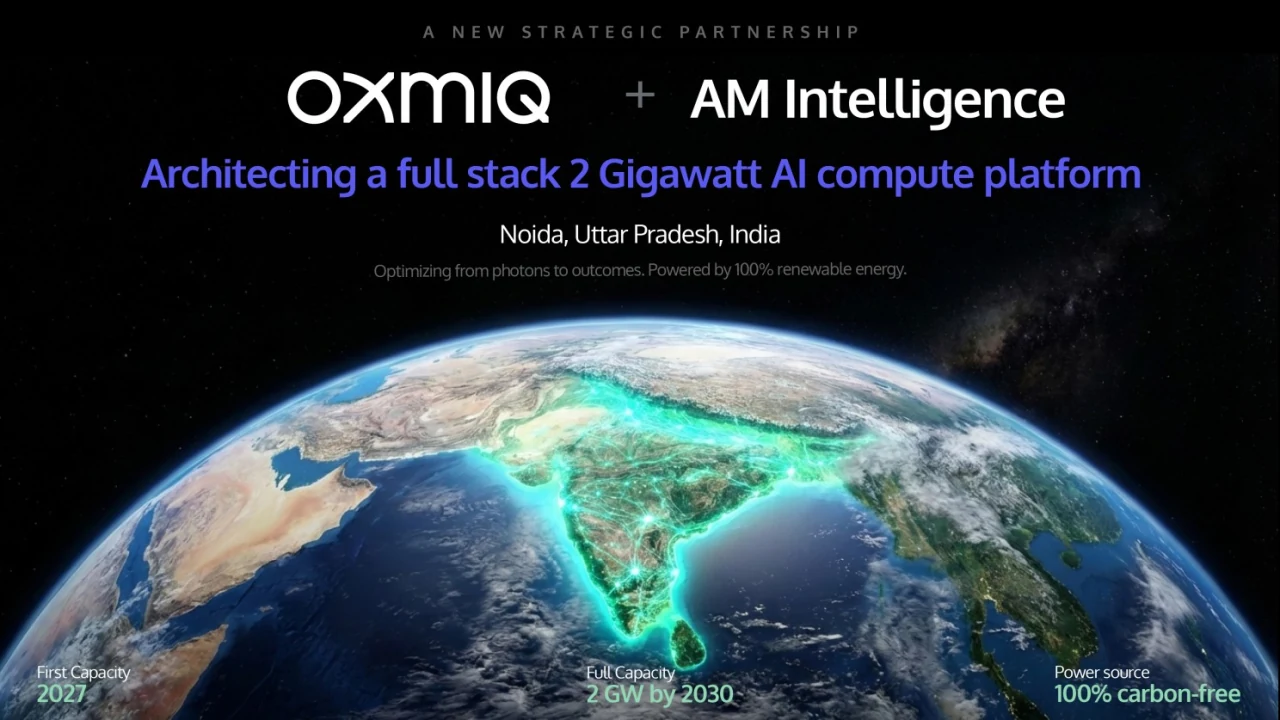
OXMIQ is partnering with AM Intelligence Labs to architect a 2 GW renewable-powered AI compute platform in Noida, Uttar Pradesh. Phase 1 brings 1 GW online by end of 2027, scaling to 2 GW by 2030. AMI Labs, a division of AM Group and sister company to Greenko, has already solved the constraint that limits most AI infrastructure at scale: reliable, carbon-free power at gigawatt scale. What they needed was the compute architecture to match.
OXMIQ is engaging from the first architectural decisions, which means the hub will be designed end-to-end as a single optimized system. Renewable energy generation, data center design, liquid cooling, interconnect topology, accelerator selection, and workload orchestration. We call this approach electrons to tokens.
The partnership also extends what licensing-first means in practice. AMI Labs is a different shape of customer than the original framing imagined: a sovereign-scale infrastructure builder bringing OXMIQ's expertise into the architecture phase of one of the largest renewable AI compute projects in the world.
Link to read more about this partnership: oxmiq.ai/blog/raja-koduri-oxmiq-new-customer-am-intelligence-to-architect-one-of-the-world's-largest-renewable-powered-ai-compute-platforms
Our team is growing
Welcome to our 17 new colleagues: Haomin Wu, Dongyan Jiang Adi Siva Prasad Reddy Korivi Jayendra Gowrishankar Dharv P. Ethan Clawsie Kyle DuVal steve hu Mohammad Shafkat M Khan Shashvath Bhaskar Thomas Eugene Green Winston Liu Ayazulla Khan Naveen Reddy Priyansh Singh Shashi Bhushan Singh and WenQi Li. This team has expanded across both Campbell and Hyderabad offices and we are actively hiring for Hardware Backend, Staff RTL Design, Finance and Operations roles. New internship opportunities are coming as well. This quarter we also moved into a temporary space while planning a larger office to support continued growth there.
What we are watching
Two things have moved faster than expected.
Customer demand for licensable GPU IP. The original first-customer profile was companies bringing new memory or interconnect technologies and needing a compute core to drive them. That category is real and active. It is also broader than the original framing, AMI Labs is one example of a customer shape that did not exist in the launch plan.
Sovereign and regional AI infrastructure. The United States, India, Middle East, Southeast Asia, parts of Europe, every region with serious AI ambitions is asking whether it can build its own compute base instead of importing it. That changes the conversation about what a GPU IP company is for.
To learn more or to view demos, reach out to tom.green@oxmiq.ai.
This newsletter publishes monthly. Subscribe, and we will see you next month.
The OXMIQ team